Operational design · Payments · Systems

I design the systems behind how companies deliver.

I’m a builder by nature: I like knowing how things work, and making them work. Over 15+ years I’ve operated at virtually every level across enterprise IT, healthcare, and fintech, as the end user, the engineer, the builder, and the executive. What I care about is how a company works on the inside, and what that means once its customers are involved.

Hiring? Here’s my experience and what I’m looking for.

Spokane Valley, WA · Remote friendly

15+
Years in tech
30+
Enterprise rollouts
10+
Integrations delivered
100+
Client sessions led

Rare combination: I’ve been every person in the room — user, builder, engineer, executive — across multiple industries, and recognize the systemic patterns that stay invisible when you stay in one lane.

View résumé
The framework

The Foundation Layer

Organizations, like products, must be intentionally designed. Read the stack top-down the way your customers experience it — then fix it bottom-up.

Experienced top-down: L5 → L1Fixed bottom-up: L1 → L5
  1. L5

    Signal

    output · where problems surface

    What customers experience, report, and reflect back.

    These are symptoms — not root causes.

  2. L4

    Delivery

    output

    What gets built, shipped, and supported.

    Quality here is a direct output of the three layers beneath it.

  3. L3

    Clarity

    foundation · where the real work lives

    Information flow, decision-making, and cross-team alignment.

    Misalignment here creates compounding friction at every layer above.

  4. L2

    Infrastructure

    foundation

    Systems, tools, documentation, and internal knowledge structures.

    When broken, teams work around it — creating invisible operational debt.

  5. L1

    Operations

    foundation · bedrock

    Roles, responsibilities, handoffs, and day-to-day workflows.

    When poorly defined, every layer above inherits the confusion.

Most problems surface at L5. Most fixes start at L1.

The framework, applied

Diagnosed by layer, fixed at the foundation

The situation, the foundation-level change, and what it produced.

  1. L1 + L3 · Operations + Clarity

    Client onboarding, rebuilt as a repeatable system

    Situation
    At an MSP serving enterprise and mid-market clients, onboarding ran on tribal knowledge. Every project worked out its own process from scratch, and context kept getting dropped in the handoffs between sales, projects, and support.
    Change
    I came in as the first dedicated Projects hire and took discovery through to close: standard SOWs, a mapped handoff path between the teams, and a set cadence for talking to the people signing.
    Outcome
    Onboarding timelines came down by more than 25%
  2. Spans L2 + L4 · Infrastructure + Delivery

    A vendor-API gate in front of the dev team

    Situation
    At a global payments platform, vendor APIs reached the development team as promises. How reliable they were, how they failed, and whether the docs were accurate all got discovered mid-build, which is the worst time to find out.
    Change
    I put a gate in front: every vendor API gets exercised for auth, edge cases and failure modes first, then written up so engineers and clients can build from it without repeating the discovery.
    Outcome
    Integration risk surfaces before commitment, not after
  3. L2 · Infrastructure

    Enterprise resilience nobody sees until it works

    Situation
    A community-health organization across 25+ locations ran systems that couldn't go down with the power. Backup coverage had grown site by site over the years, and nobody owned it as a whole.
    Change
    I took it on company-wide: audited every site, standardized how coverage was supposed to work, and turned surviving an outage into something we'd actually checked rather than assumed.
    Outcome
    Critical systems survived outages across the whole organization
Selected work

Real systems, open on this site

Flagship · Working software

UAT-Ops

An API-integration and onboarding workbench for payment-provider UAT — spec ingestion, live sandbox execution, flow testing, and a governed AI layer.

endpoints
1,262
sandbox executions
5,800+
onboarding runs
76
tests green
5,400+

Metrics verified · 28 Sep 2026. Counted from the live database and test suite, current sandboxes only.
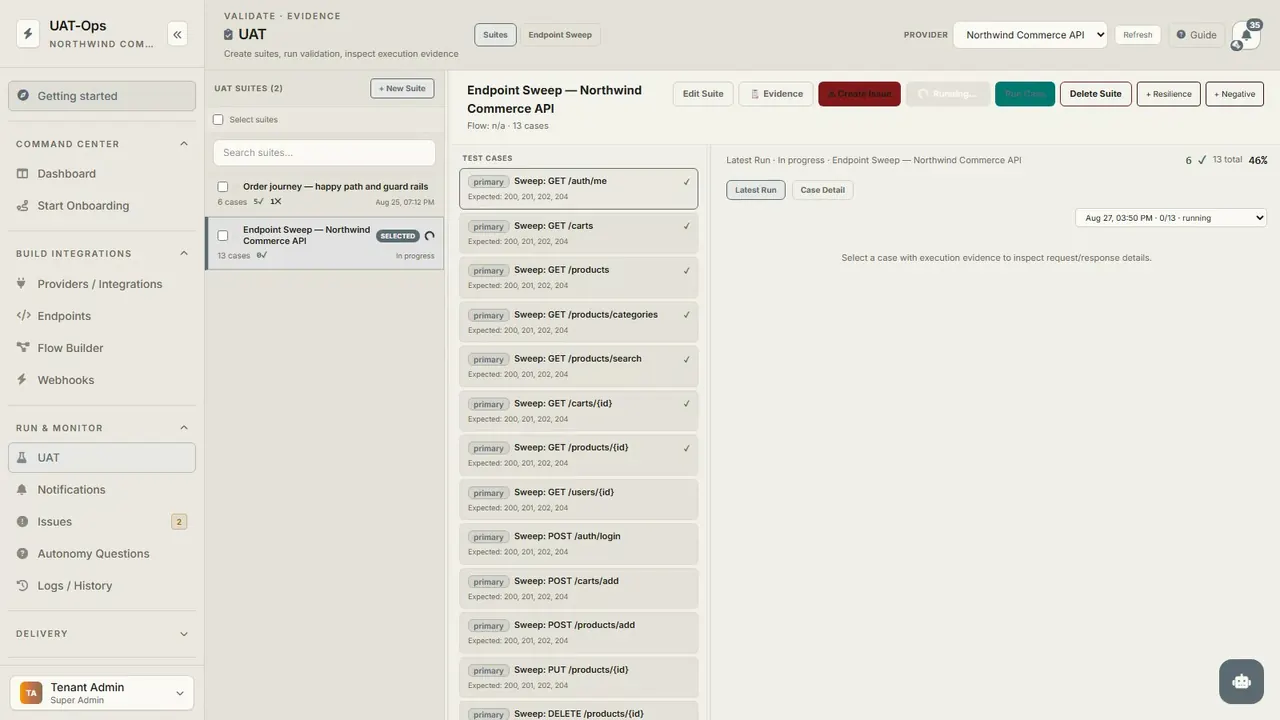
UAT-Ops walkthrough preview

All work and writing

About

Helpdesk to director, and a builder the whole way

I started on a helpdesk, and I’ve since worked at nearly every level above it: systems engineering, account management, project delivery, a startup I co-founded, and director-level solutions work in payments. The thing I’m best at hasn’t changed: getting to the root cause quickly, whether the problem is a system or a room full of frustrated people.

The longer version
Contact

Building a team, or fixing a system?

Have a problem worth solving?

I’m taking on consulting engagements now, project-based or retainer, across fintech, SaaS, and beyond — the problems I solve aren’t industry-specific.

Hiring?

I’m open to the right role too: hands-on, somewhere I can shape how the company works internally and see what that means for its customers.

Loading verification…